01Real entry-level openings
Companies hire for these roles at L1 level all year, so you don't need past experience in the same job.
A career gap doesn't close doors in IT. Entry roles in networking, IT support, security, data and marketing hire people who can show current skills. Here are the career restart jobs that fit, the course that leads to each, starting salaries and a 30-day plan to get hired, backed by our placement record.


Book your free career counselling. No spam.
Placement Guarantee hai
to Form Bharne mai Deri kyun?
Training IT careers in Mumbai
Careers transformed
Non-IT to IT career switches
Hiring partners
The best career restart jobs in 2027 are entry-level IT roles that hire on skills: network support engineer, NOC engineer, desktop support engineer and Windows system administrator need no coding, while SOC analyst, data analyst, web developer and digital marketing executive suit specific interests. Most people reach these jobs after 3 to 6 months of training, and Awdiz students start at ₹2.4 LPA to ₹8 LPA.
Each job below comes with the course that leads to it, the usual work mode at the start and where it grows. If you are still choosing between a company returnship and a training program, read our guide to career restart programs in India first.
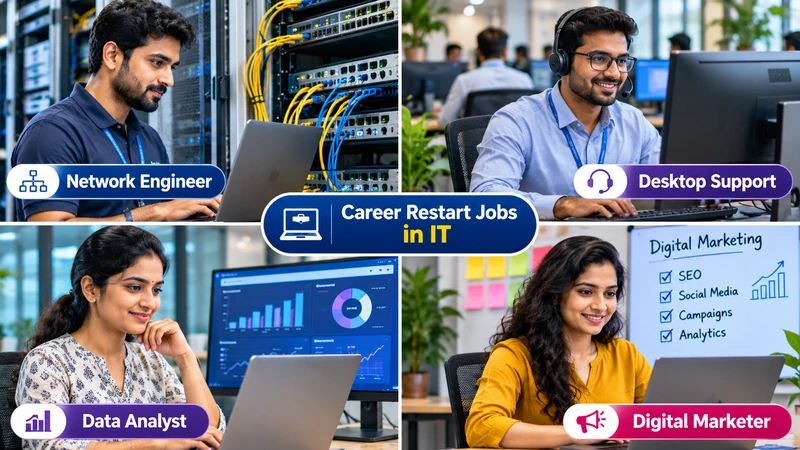
Not every job is kind to a gap on the resume. The jobs in this guide share three things that make them realistic after a break.
Companies hire for these roles at L1 level all year, so you don't need past experience in the same job.
Interviews check what you can configure, fix or analyse today. A recent course and lab work matter more than when you last worked.
Each role has an obvious next step, so the restart is the first rung of a career, not a dead end.
Every role below is one that Awdiz trains for and places students into. Start with the first group if you want a job quickly without coding.
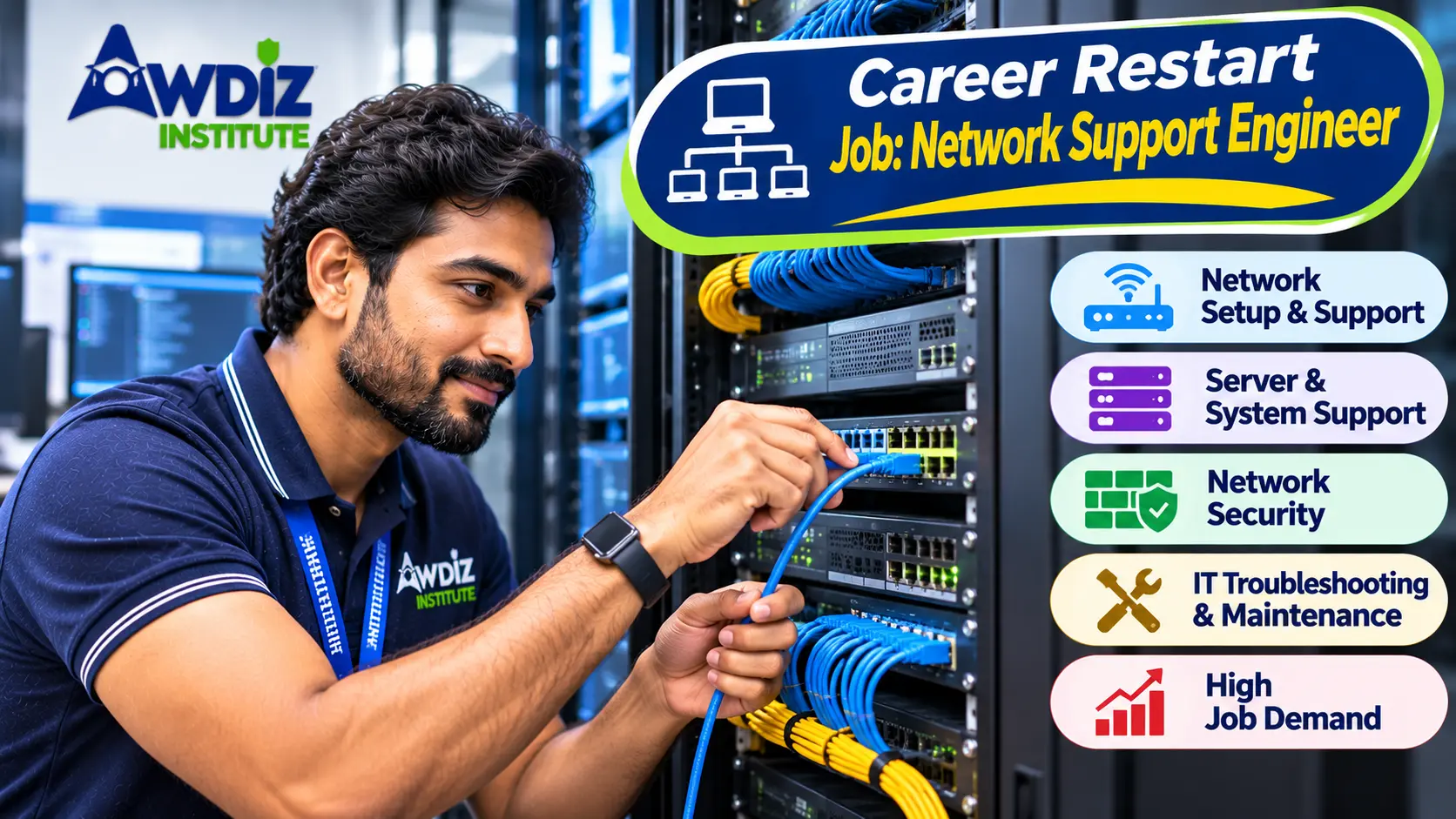
You keep a company's internet, Wi-Fi, routers and switches running, and fix issues when users lose connection. It is the most common first job after CCNA and a stable start for graduates from any stream.
| Course to learn | CCNA course |
|---|---|
| Work mode at start | On site, day or rotational shifts |
| Grows into | Network engineer, then senior network engineer |
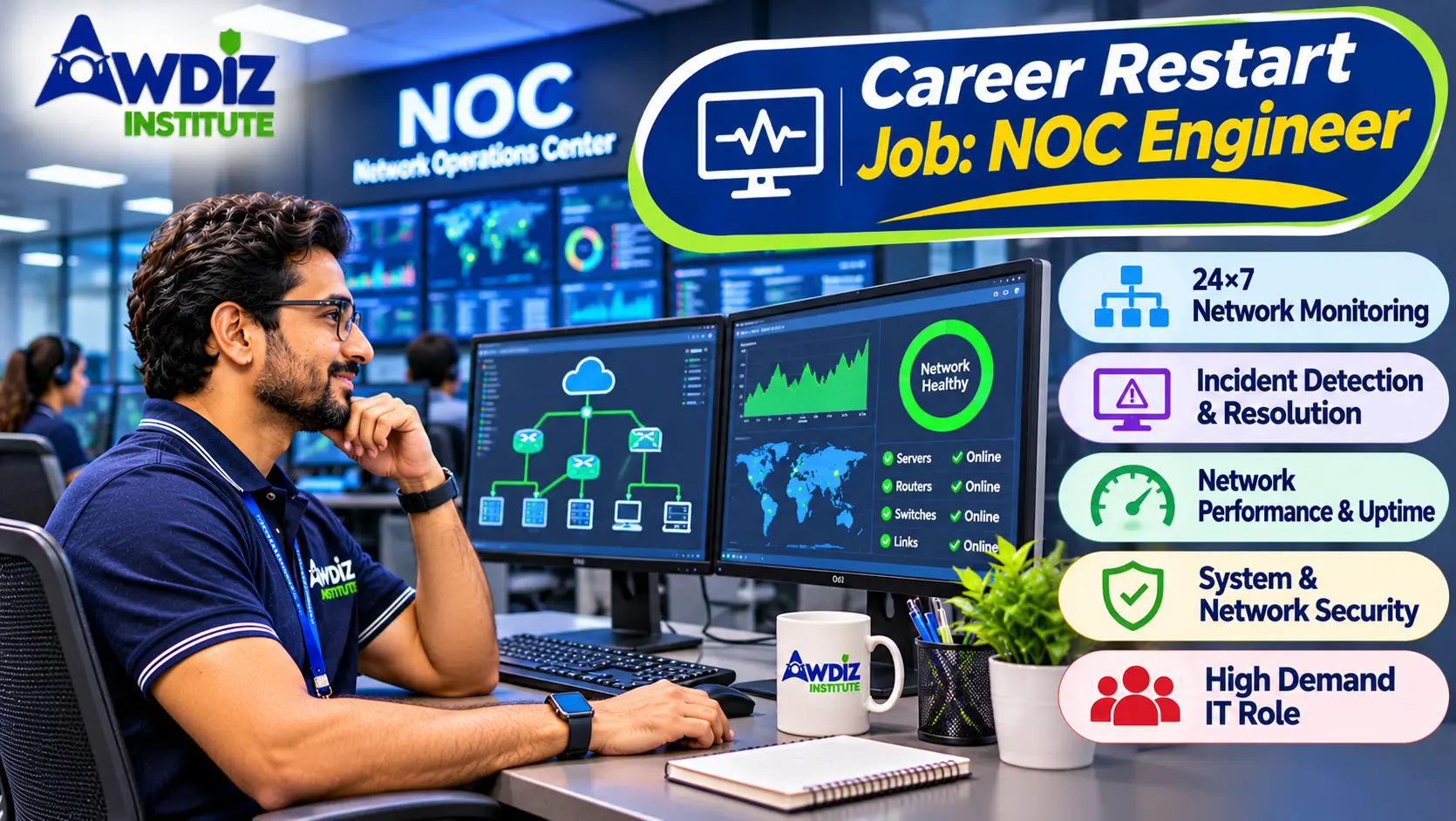
In a Network Operations Centre you watch dashboards for network alerts and act before users notice a problem. Companies run NOCs round the clock, so they hire steadily at entry level.
| Course to learn | CCNA course |
|---|---|
| Work mode at start | On site, 24x7 shifts |
| Grows into | NOC L2, then network engineer |
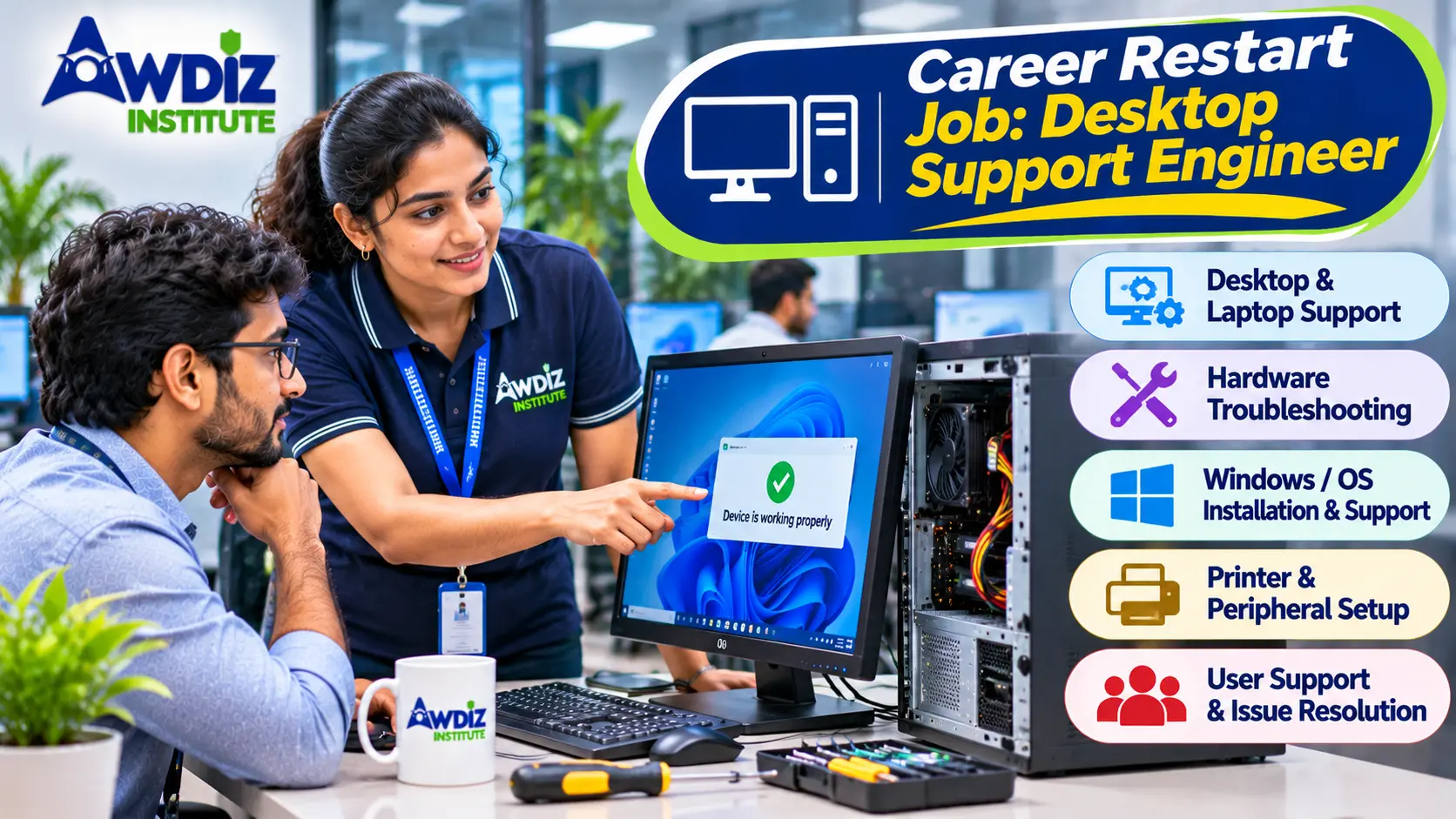
You set up laptops, install software, fix printer and email problems and help staff with day-to-day IT issues. It is the easiest first step into IT and suits people from BPO and support jobs.
| Course to learn | Windows Administrator course · Hardware & Networking course |
|---|---|
| Work mode at start | On site, general shift |
| Grows into | System administrator, then IT infrastructure lead |
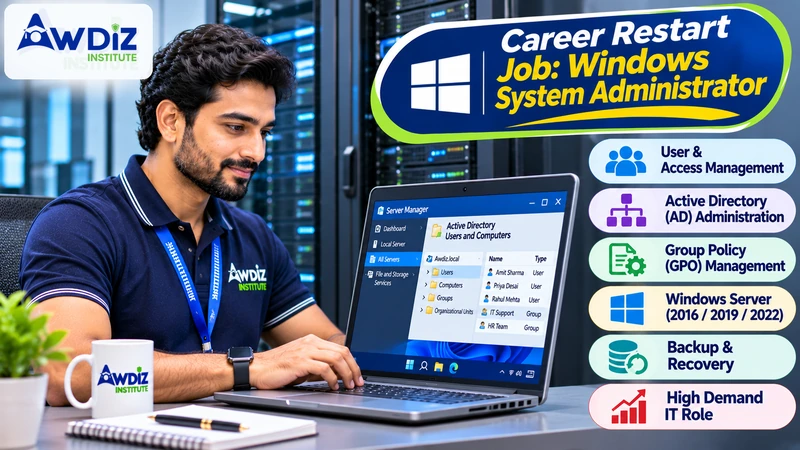
You manage the Windows servers, user accounts, permissions and backups a company depends on. Our students Ganesh and Dnyaneshwar restarted their careers in this role.
| Course to learn | Windows Administrator course |
|---|---|
| Work mode at start | On site, can turn hybrid with experience |
| Grows into | Senior system admin, then cloud or infrastructure engineer |
These four jobs need no coding. CCNA or Windows admin training gets you interview-ready fastest.
Check Next Batch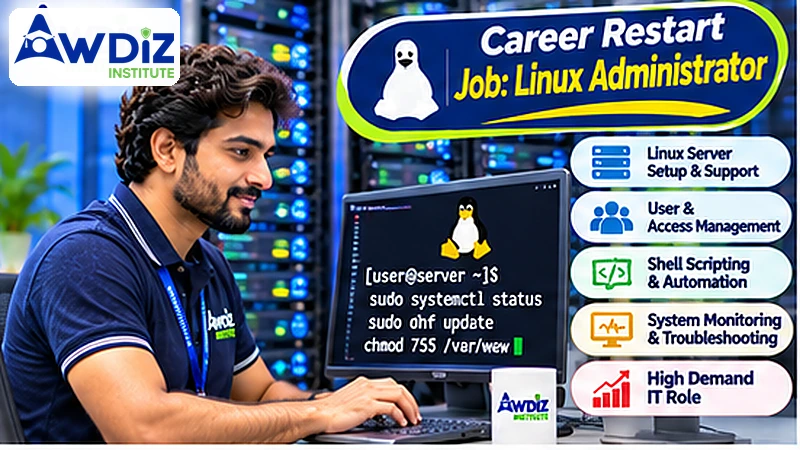
You run the Linux servers that host websites, apps and databases, and keep them updated and secure. It pairs well with networking and leads naturally into cloud jobs.
| Course to learn | Linux Administrator course |
|---|---|
| Work mode at start | On site or hybrid |
| Grows into | Senior Linux admin, then DevOps or cloud engineer |
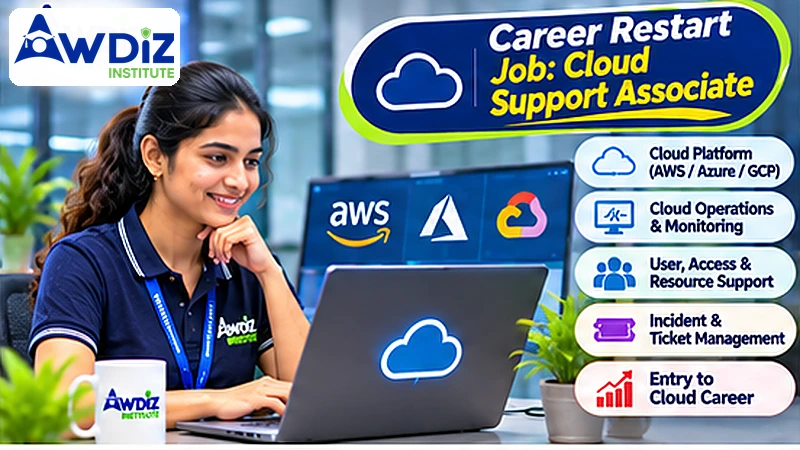
You help set up, monitor and troubleshoot services running on the cloud. As more companies move to the cloud, this role keeps growing.
| Course to learn | AWS course |
|---|---|
| Work mode at start | Hybrid in many companies |
| Grows into | Cloud engineer, then cloud architect |
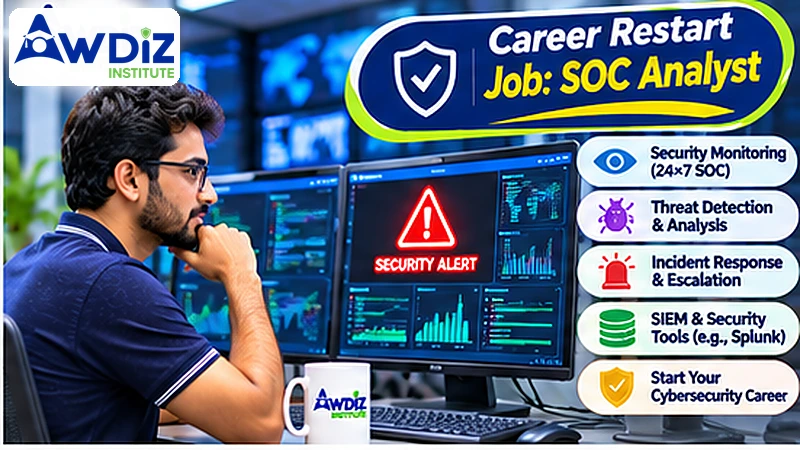
In a Security Operations Centre you check security alerts, spot attacks such as phishing and escalate real threats. No coding is needed to start, and careful, steady people do well here.
| Course to learn | Cyber Security course |
|---|---|
| Work mode at start | On site, often shifts |
| Grows into | SOC L2, then security engineer or VAPT specialist |

You turn company data into reports and dashboards using Excel, SQL and Power BI. It suits people from finance, accounts and operations, whose business sense becomes an advantage.
| Course to learn | Data Analyst course |
|---|---|
| Work mode at start | Hybrid or remote in many companies |
| Grows into | Senior analyst, then business or data analytics lead |

You build simple prediction models and use AI tools to answer business questions. It needs steady study, so it suits people who enjoy maths and Python.
| Course to learn | Data Science course |
|---|---|
| Work mode at start | Hybrid or remote in many companies |
| Grows into | Data scientist, then ML engineer |
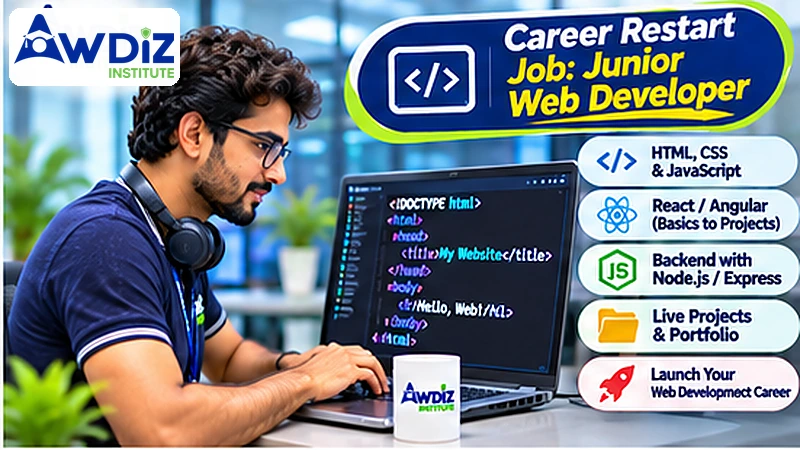
You build and fix the screens, features and databases behind websites and apps. It suits people who like logic and building things, especially those under 35.
| Course to learn | Full Stack course |
|---|---|
| Work mode at start | Hybrid or remote in many companies |
| Grows into | Full stack developer, then senior developer |

You run SEO, social media and online ad campaigns that bring customers to a business. It works for a job, for freelancing or for growing your own business.
| Course to learn | Digital Marketing course |
|---|---|
| Work mode at start | Hybrid, remote or freelance |
| Grows into | Marketing manager, or your own agency |
Awdiz students, freshers and restarters alike, usually start between ₹2.4 LPA and ₹8 LPA. Where you land in that range depends on the role, your skills in the interview, the city and the company. Here are all 11 jobs at a glance.
| Job role | Course | Coding? | Work mode at start |
|---|---|---|---|
| Network Support Engineer | CCNA | No coding | On site, day or rotational shifts |
| NOC Engineer (L1) | CCNA | No coding | On site, 24x7 shifts |
| Desktop Support Engineer | Windows Administrator / Hardware & Networking | No coding | On site, general shift |
| Windows System Administrator | Windows Administrator | No coding | On site, can turn hybrid with experience |
| Linux Administrator | Linux Administrator | Server work | On site or hybrid |
| Cloud Support Associate | AWS | Cloud | Hybrid in many companies |
| SOC Analyst (L1) | Cyber Security | High demand | On site, often shifts |
| Data Analyst / MIS Executive | Data Analyst | Light coding | Hybrid or remote in many companies |
| Junior Data Scientist | Data Science | Coding | Hybrid or remote in many companies |
| Junior Web Developer | Full Stack | Coding | Hybrid or remote in many companies |
| Digital Marketing Executive | Digital Marketing | No coding | Hybrid, remote or freelance |
Growth is where a restart pays back. Here is how a typical networking career moves once you are in:
Network support or NOC engineer. Learn the live network, the tools and the ticket process.
Network engineer. Handle changes and projects, and add advanced networking or security skills.
Senior engineer, security or cloud specialist. Pay rises with each specialist skill you add.
Salary figures are the range seen across Awdiz placements, not a promise for any single role. See real student outcomes on our placement record page.
Awdiz places students across India, from classroom batches at Bandra and Vashi and from live online batches. These five cities have the most openings for restart roles.
Banks, IT services and data centres across Andheri, Powai, BKC, Vashi and Airoli hire for support, network and security roles. Train at our Bandra or Vashi centre: cyber security course in Mumbai.
Hinjewadi, Kharadi and Magarpatta are packed with IT companies that hire for infrastructure and data roles. See the cyber security course in Pune.
India's largest tech hub, with openings in cloud, security, data and development around Whitefield and Electronic City. See the cyber security course in Bangalore.
HITEC City and Gachibowli host large IT and global capability centres that hire for support and security. Join a live online batch through our IT training institute in India.
OMR and Guindy have a strong market for network and infrastructure jobs. See the network administrator course in Chennai.
Learn live online with recorded lectures and cloud labs, and get placement support for jobs across India. Ask about online batches.
Yes, but it depends on the role. ₹30,000 a month is about ₹3.6 LPA, which sits inside the usual starting range, so the question is which jobs allow remote work from day one.
You can still train from home for any of these roles through our live online batches, with recordings for every class. Women looking for remote work can read our guide to remote career restart jobs for women, and everyone can see the full list of work-from-home career restart jobs.
Training makes you ready. These four weeks turn that readiness into offers.
Put recent training and projects at the top, add the gap as one honest line, and set your LinkedIn headline to the role you want.
Do mock technical rounds on your course topics and rehearse a 30-second answer about your break.
Interviews through the placement team, plus your own applications on job portals for the exact role title.
Attend every round, send a short thank-you note, and learn from each interview before the next one.
Most working candidates need 30 to 90 days to join. You can join right away. When a company needs someone fast, tell them clearly: “I can join immediately.” For urgent hiring, that sentence can move you ahead of a candidate with more experience.
Training is half the job. The other half is getting in front of the right companies. Here is what our placement support covers.
| Detail | What you get |
|---|---|
| Where you get placed | Across India, for both classroom and online students |
| Starting salaries | ₹2.4 LPA to ₹8 LPA for freshers and restarters, depending on role and skills |
| Hiring network | 100+ hiring partners across IT services, banks, data centres and startups |
| Before interviews | Resume and LinkedIn building, mock technical interviews and practice for the career-gap question |
| Ways to learn | Classroom at Bandra or Vashi, live online or hybrid, with every lecture recorded |
| Batches | Weekday morning, afternoon and evening, weekends, and 8 to 11 pm for working people |
Ready to start? Book a free counselling call and find out the next batch for your role.
Book My CallDesktop support, system support, network support and more: hear from students now working in these jobs.
A 2018 BSc CS graduate who moved from a non-IT role to L1 Desktop Support Engineer at 2.4 LPA.
A 2020 B.Com graduate who completed the Windows Administration program.
From Nagpur, he worked in a non-IT role after his 2020 MBA and became a System Engineer at 2.7 LPA with zero IT experience.
A 2022 BSc IT graduate who, after a 2-year gap, started as a Network Support Engineer in Mumbai at 2.5 LPA.
Kiran moved into tech and was placed as a network support engineer.
Ganesh finished his diploma in 2019 and came back through Windows admin training.
Yes. Employers hire people after a break when they can see current skills. A short job-focused course, hands-on labs or projects and a clear one-line explanation of the gap are usually enough to get shortlisted.
Yes. A 1-year gap is easy to explain. Use the time to finish a practical course such as CCNA or Windows administration, and mention it as recent training at the top of your resume.
Pick one entry role, train for 3 to 6 months with labs and projects, explain the gap honestly in one line, and apply through a placement team that works with large hiring partners rather than only through job portals.
Yes. Entry IT roles such as network support, desktop support, SOC analyst and data analyst hire on skills. Your work maturity helps, especially in support and security roles.
No. At 38, choose roles where reliability and past work experience count, such as IT infrastructure, security or data, and learn through a short course with interview practice.
Networking and system administration are the quickest starts with no coding. Cyber security and data analyst suit people who like problem solving. Full stack development suits those who enjoy coding.
IT support roles such as desktop support or Windows administration are among the easiest to switch to, because they need no coding and can be learned in a short course.
No. At 27 you are still close to a fresher in most hiring, so you can start in almost any IT role, including coding paths like full stack or data science.
₹30,000 a month is about ₹3.6 LPA, which is within the usual starting range for IT roles. Remote-friendly options include development, data analysis and digital marketing, after a course and some project work.
Awdiz students, both freshers and people restarting after a break, usually start between ₹2.4 LPA and ₹8 LPA, depending on the role, skills, city and company.

Returnships vs training programs, a 5-step plan and how to explain your gap.
Read more →
Course-by-course guide with fees, duration, coding needs and first job roles.
Read more →
8 IT jobs for women after a break, with shift timings, work mode and salary.
Read more →Tell us your background and your gap. We will suggest a role, the course that leads to it and the next batch. Placements across India, for classroom and online students.